
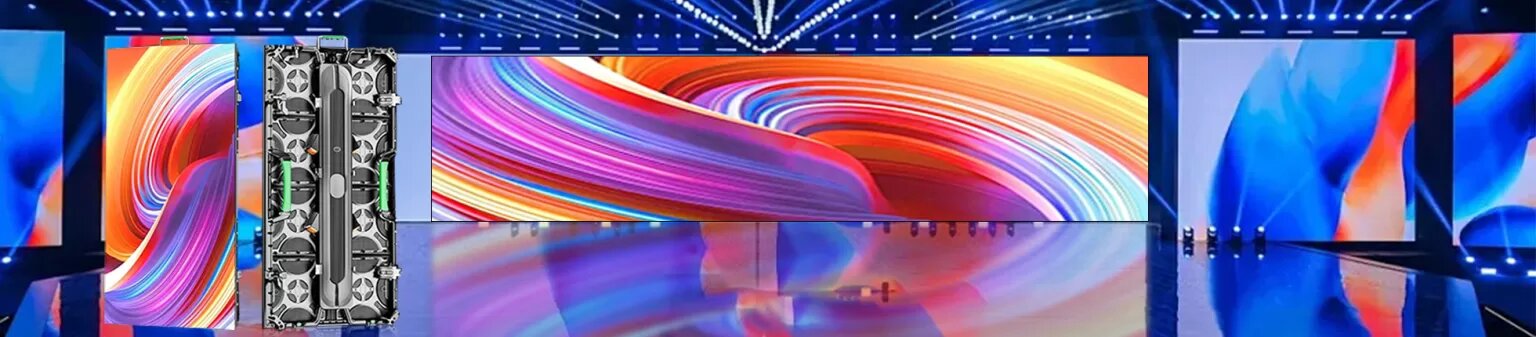
As companies continue to upgrade their meeting spaces, experience centers, exhibition halls, and digital showrooms, traditional projectors and LCD displays are increasingly being replaced by fine-pitch LED displays.
An LED video wall can create a seamless, large-format visual experience without the bezels found in multi-screen LCD video walls. It can be used for presentations, video conferences, product launches, corporate branding, interactive demonstrations, immersive content, and digital storytelling.
However, choosing the right LED display is not simply about buying the smallest pixel pitch available.
A P1.2 LED display is not automatically better than a P2.5 display. A higher-resolution screen may also create unnecessary costs if the viewing distance, screen size, content type, and application do not require it.
In this 2026 Conference Room and Digital Showroom LED Display Buying Guide, we will explain how to choose the right LED screen based on:
- Viewing distance
- Room size
- Pixel pitch
- Screen resolution
- COB vs. SMD technology
- Brightness and contrast
- Content requirements
- Installation method
- Maintenance requirements
- Budget
Let's get started.
. Why Are LED Displays Becoming Popular in Conference Rooms and Digital Showrooms?
Modern commercial spaces require more than just a screen.
A conference room display may need to show:
- PowerPoint presentations
- Excel spreadsheets
- Video conferences
- CAD drawings
- Dashboards and real-time data
- Product demonstrations
A digital showroom or exhibition hall may require:
- Immersive video content
- Brand storytelling
- Product launches
- Interactive presentations
- 3D visual effects
- High-resolution images
- Digital art installations
LED displays provide several advantages over traditional projection systems and LCD video walls.
Seamless Large Format
LED displays can be built into almost any size or aspect ratio. Unlike LCD video walls, there are no visible bezels between panels.
High Brightness
LED displays can maintain strong image visibility in environments with higher ambient light.
Flexible Screen Size
From a small corporate meeting room to a large immersive digital showroom, the LED screen can be customized according to the available installation space.
Long-Term Commercial Use
For permanent installations, LED displays are designed for frequent and long-term operation, making them suitable for corporate and commercial environments.
Premium Visual Experience
Fine-pitch LED technology makes it possible to display text, graphics, video, and detailed visual content at closer viewing distances.
In 2026, applications such as corporate boardrooms, command centers, premium retail spaces, and exhibition environments increasingly use fine-pitch LED displays, with the correct pixel pitch depending heavily on viewing distance and content requirements.
2. Conference Room LED Display vs. Digital Showroom LED Display
Although both applications may use indoor LED displays, their requirements are often different.
| Feature | Conference Room | Digital Showroom |
|---|---|---|
| Main Purpose | Meetings and presentations | Brand experience and product display |
| Viewing Distance | Usually close | Close to long distance |
| Content | Text, charts, documents, video | Video, animation, images, immersive content |
| Pixel Pitch | Usually P1.2–P2.5 | Usually P1.5–P3 |
| Brightness | Moderate | Depends on ambient lighting |
| Refresh Rate | Important for video conferencing | Important for video and camera shooting |
| Screen Shape | Usually 16:9 or custom | Flat, curved, corner, or creative |
| Technology | SMD or COB | SMD, GOB, or COB |
The key is to select the LED display based on the actual application, rather than simply choosing the smallest pixel pitch.
3. How to Choose the Right Pixel Pitch
Pixel pitch is one of the most important factors when choosing an LED display.
It refers to the distance between the centers of two adjacent pixels.
For example:
- P1.2 = 1.2 mm pixel pitch
- P1.5 = 1.5 mm pixel pitch
- P1.8 = 1.8 mm pixel pitch
- P2.5 = 2.5 mm pixel pitch
- P3 = 3 mm pixel pitch
Generally, a smaller pixel pitch provides higher pixel density and better image detail at close viewing distances.
However, smaller pixel pitch also increases the cost.
.jpg "675f83da999cd96b5fa29ee2801e7df(1).jpg")
Recommended Pixel Pitch for Conference Rooms
P1.2–P1.5: Premium Boardrooms
Best for:
- Executive boardrooms
- High-end corporate offices
- Financial institutions
- Command centers
- Rooms with close viewing distances
This range is suitable when viewers are sitting close to the screen and the content includes detailed text, spreadsheets, data, and graphics.
P1.5–P1.8: High-Quality Corporate Meeting Rooms
Best for:
- Medium-sized conference rooms
- Video conferencing rooms
- Corporate presentation spaces
- Training centers
This range provides an excellent balance between image quality and budget.
P1.8–P2.5: Standard Conference Rooms
Best for:
- Medium and large meeting rooms
- Training rooms
- Corporate presentation rooms
- Multipurpose spaces
For many projects, this range offers a strong balance between cost and visual performance.
P2.5–P3: Large Meeting and Presentation Spaces
Best for:
- Large training rooms
- Auditoriums
- Large exhibition areas
- Digital showrooms
- Spaces with longer viewing distances
Industry guidance for 2026 generally places corporate boardrooms and close-viewing applications around P1.2–P2.0, while larger conference rooms and commercial spaces can often use P2.0–P3 more cost-effectively.

4. How to Calculate the Best Pixel Pitch for Your Project
A simple starting point is:
Smaller viewing distance = smaller pixel pitch
However, you should not select the pixel pitch based on distance alone.
You should also consider:
- The closest viewing distance
- The average viewing distance
- The type of content
- The screen size
- The required resolution
- The project budget
For example:
Example 1: Small Executive Meeting Room
- Closest viewer: 2 meters
- Screen size: 110–150 inches equivalent
- Content: Excel, PowerPoint, video conference
Recommended:
P1.2–P1.5 LED display
Example 2: Medium Conference Room
- Closest viewer: 3 meters
- Screen size: 150–200 inches
- Content: Presentations, video, charts
Recommended:
P1.5–P2.0 LED display
Example 3: Large Digital Showroom
- Closest viewer: 4–6 meters
- Large installation area
- Main content: Brand videos and product visuals
Recommended:
P2–P3 LED display
The important point is that the smallest pixel pitch is not always the best investment. Matching the display to the actual viewing distance can avoid unnecessary project costs.
5. COB vs. SMD: Which LED Technology Should You Choose?
In 2026, both COB and SMD technologies remain important for indoor LED display projects.
What Is an SMD LED Display?
SMD stands for Surface-Mounted Device.
SMD technology is mature and widely used across many LED display applications.
Advantages of SMD
- Mature technology
- Cost-effective
- Wide range of pixel pitches
- Flexible product selection
- Suitable for many commercial indoor projects
- Easier access to replacement modules and components
SMD remains a practical choice for many conference rooms, showrooms, training rooms, and large indoor displays.
What Is a COB LED Display?
COB stands for Chip on Board.
Instead of using traditional packaged LED lamp beads in the same way as SMD, COB technology integrates the LED chips directly onto the board and protects the display surface with an encapsulation layer.
Advantages of COB
- Smooth display surface
- Higher physical protection
- Excellent contrast
- Suitable for ultra-fine pixel pitches
- Better performance for close viewing
- Good option for premium indoor applications
COB is particularly attractive for premium boardrooms, control rooms, high-end meeting spaces, and other applications requiring very fine pixel pitch and close viewing.

6. COB vs. SMD: Quick Comparison
| Feature | SMD LED Display | COB LED Display |
| Cost | More economical | Higher initial cost |
| Fine Pixel Pitch | Good | Excellent |
| Surface Protection | Standard | Higher |
| Close Viewing | Good | Excellent |
| Maintenance | Flexible | Module-level service may be required |
| Large Commercial Screens | Excellent | Good |
| Premium Boardrooms | Good | Excellent |
| Digital Showrooms | Excellent | Excellent |
| Budget Projects | Excellent | Less suitable |
Our Recommendation
Choose SMD when:
- Budget is important
- Viewing distance is moderate
- Pixel pitch is P1.5 or above
- You need a cost-effective large-format screen
Choose COB when:
- Viewers are very close to the screen
- You require ultra-fine pixel pitch
- Surface protection is important
- The project is a premium boardroom or mission-critical environment
COB is increasingly positioned for high-end fine-pitch applications, while SMD remains a cost-effective option across general commercial LED installations.

7. What Screen Size Should You Choose?
Screen size should match the room dimensions and the number of participants.
A screen that is too small may make text difficult to read.
A screen that is too large may increase cost unnecessarily and create an uncomfortable viewing experience.
Before choosing the screen size, consider:
- Room width
- Room depth
- Ceiling height
- Number of seats
- Closest viewing distance
- Farthest viewing distance
- Type of content
For many corporate projects, the LED screen should be designed together with the meeting table, seating arrangement, camera position, lighting, and audio system.
8. 16:9, 21:9, or Custom Aspect Ratio?
The aspect ratio of the LED display is another important consideration.
16:9 LED Display
This is the most common format for:
- PowerPoint presentations
- Video conferences
- Standard video content
- Corporate presentations
It is often the easiest choice for conference rooms.
21:9 Ultra-Wide LED Display
Suitable for:
- Premium boardrooms
- Multi-window presentations
- Large video conferences
- Modern collaboration spaces
An ultra-wide screen can display multiple content windows at the same time.
For example:
- Speaker video
- Presentation
- Meeting participants
- Data dashboard
Custom Aspect Ratio
Digital showrooms may require a completely customized design.
Examples include:
- Ultra-wide LED walls
- Curved LED displays
- Corner LED screens
- Floor-to-wall LED installations
- Immersive LED rooms
The aspect ratio should match the content strategy and the architectural design.
9. Brightness: Higher Is Not Always Better
For indoor conference rooms, extremely high brightness is usually unnecessary.
Excessive brightness can create visual discomfort, especially when participants are sitting close to the screen for long periods.
Instead, the display should be selected according to the ambient lighting environment.
Consider:
- Natural sunlight
- Ceiling lighting
- Window position
- Wall color
- Screen location
- Presentation duration
A professional conference room LED display should provide stable image quality under normal office lighting conditions.
For digital showrooms with stronger lighting or large open spaces, higher brightness may be required.
10. Refresh Rate and Image Quality
Refresh rate is especially important when the LED display will be used for:
- Video conferencing
- Photography
- Corporate video production
- Livestreaming
- Digital content recording
A higher refresh rate can help improve camera performance and reduce visible scanning artifacts.
For standard corporate applications, buyers should focus on the complete visual system rather than only one specification.
Important factors include:
- Refresh rate
- Grayscale performance
- Brightness uniformity
- Color consistency
- Contrast
- Viewing angle
- Low-brightness performance
11. Front Maintenance or Rear Maintenance?
For most permanent conference room and showroom installations, front maintenance is highly recommended.
Front service allows technicians to access:
- LED modules
- Power supplies
- Receiving cards
from the front of the display.
This can reduce the space required behind the LED screen.
Front maintenance is especially useful when the LED display is installed directly against a wall.
Before purchasing, confirm the maintenance design with your LED supplier and AV integrator.

12. Consider the Complete AV System
An LED display should not be treated as an isolated product.
For a conference room, the complete system may include:
- LED video wall
- Video processor
- Wireless presentation system
- Video conference camera
- Microphone
- Speakers
- Control system
- Central management software
For a digital showroom, the system may also include:
- LED displays
- Media servers
- Interactive sensors
- Touch systems
- Audio systems
- Lighting control
- Content management systems
A great LED display can still deliver a poor user experience if the entire AV system is not properly integrated.
13. Common Mistakes When Buying a Conference Room LED Display
Mistake 1: Choosing the Smallest Pixel Pitch
A smaller pixel pitch does not automatically mean a better project.
If the viewing distance is 5 meters, a P1.2 display may provide little practical advantage over a more suitable P1.8 or P2.5 configuration.
Mistake 2: Ignoring Resolution
Buyers often focus on pixel pitch but forget to calculate the total screen resolution.
The physical size and pixel pitch together determine the final resolution.
Mistake 3: Ignoring Content Type
If your main content is Excel spreadsheets and technical drawings, resolution is extremely important.
If your main content is immersive video, screen size and visual impact may be more important.
Mistake 4: Choosing a Screen Without Considering Maintenance
Always confirm:
- Front or rear service
- Spare modules
- Power supply access
- Receiving card access
- Warranty policy
Mistake 5: Focusing Only on Price
The cheapest LED display may create additional costs later through:
- Higher maintenance requirements
- Poor color consistency
- Limited spare parts
- Difficult installation
Poor after-sales support

14. Recommended LED Display Configurations for 2026
| Application | Recommended Pixel Pitch | Recommended Technology |
| Executive Boardroom | P1.2–P1.5 | COB or Premium SMD |
| Medium Conference Room | P1.5–P2.0 | SMD or COB |
| Large Conference Room | P1.8–P2.5 | SMD |
| Training Center | P1.8–P2.5 | SMD |
| Corporate Lobby | P1.5–P2.5 | SMD, GOB, or COB |
| Digital Showroom | P1.5–P3 | SMD, GOB, or COB |
| Immersive Exhibition | Customized | Depends on project |
| Control Room | P0.9–P1.5 | COB |
| High-Traffic Interactive Area | P1.5–P2.5 | GOB or COB |
These recommendations should be treated as starting points; final specifications should be based on actual viewing distance, content, installation conditions, maintenance access, and budget.
15. FAQ
What is the best LED display for a conference room?
For many standard conference rooms, a P1.5 to P2.5 LED display offers a good balance between image quality and cost.
Premium boardrooms with closer viewing distances may benefit from P1.2 to P1.5 fine-pitch LED displays.
Is COB better than SMD?
Not always.
COB is an excellent option for premium fine-pitch and close-viewing applications, especially where surface protection and contrast are priorities.
SMD remains a highly practical and cost-effective solution for many conference rooms and digital showroom projects.
What pixel pitch is suitable for a digital showroom?
For many digital showrooms, P1.5 to P3 can be suitable.
The final choice depends on the closest viewing distance and the type of content being displayed.
Can an LED display replace a projector in a meeting room?
Yes.
An LED display can provide a seamless large-format image without requiring the projection distance and screen alignment associated with traditional projectors.
However, the initial investment and technical requirements should be evaluated before making a decision.
Should I choose a 16:9 LED screen?
For standard presentations and video conferencing, 16:9 is usually the safest choice.
For premium collaboration rooms and multi-window applications, 21:9 ultra-wide LED displays can also be considered.
Conclusion: How to Choose the Right LED Display in 2026
The best conference room or digital showroom LED display is not necessarily the one with the smallest pixel pitch or the highest price.
The right solution should balance:
- Viewing distance
- Screen size
- Resolution
- Content type
- Pixel pitch
- COB vs. SMD technology
- Brightness
- Installation
- Maintenance
- Budget
For most standard conference rooms, P1.5–P2.5 indoor LED displays provide an excellent balance between image quality and cost.
For premium executive boardrooms and close-viewing applications, P1.2–P1.5 fine-pitch LED displays, including COB solutions, may provide a more refined visual experience.
For digital showrooms, the best choice depends on whether the goal is high-resolution information display, immersive storytelling, brand presentation, or large-format visual impact.
The most important step is to design the LED display around your actual application.
At StarOE, we can help you evaluate your room size, viewing distance, screen dimensions, content requirements, and budget to recommend a customized LED display solution for your conference room, digital showroom, exhibition space, or corporate environment.
Ready to Start Your LED Display Project?
Contact the StarOE team for a customized LED display solution based on your project requirements.
Tell us your:
- Installation location
- Screen size
- Viewing distance
- Application
- Preferred pixel pitch
- Installation method
We will help you select a suitable LED display solution for your project.
Tel: +86 13691801582
E-mail: staroeled@163.com
Whatsapp: +86 13691801582Add: Ranked 2th floor,Buiding C,Wanda Industril Area,Shiyan town,
Baoan District, Shenzhen, China


.png "1(1).png")

Copyright 2014-2024 Shenzhen StarOE Technology Co., Ltd. All Rights Reserved.